Military Time Chart Explained | Complete Guide to the 24-Hour Clock (2026)
Military time, also known as the 24-hour clock, is one of the most reliable and widely used systems for telling time. If you’ve ever felt confused by times like 18:45 or 23:30, you’re not alone. This guide explains military time in a simple, practical way—so by the end, reading it will feel natural and effortless.
Military time exists to remove ambiguity. Unlike the 12-hour clock, which relies on “a.m.” and “p.m.”, the 24-hour system runs straight through the day, from midnight to midnight, without resetting. This makes it especially useful in situations where precision matters.
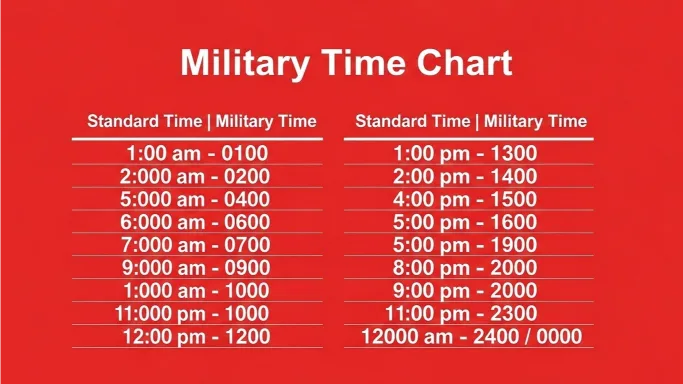
What Is Military Time and Why Does It Exist?
Military time is based on a 24-hour clock where each day starts at 00:00 (midnight) and ends at 23:59, the final minute before the next day begins. Instead of repeating hours, every hour of the day has a unique number.
The system was adopted to prevent confusion in critical environments. When timing must be exact—such as during military operations, medical care, aviation, or emergency response—there’s no room for misunderstanding whether a time refers to morning or evening.
Today, military time is not limited to the armed forces. It’s used worldwide in transportation systems, hospitals, weather forecasting, astronomy, scientific research, and digital systems.
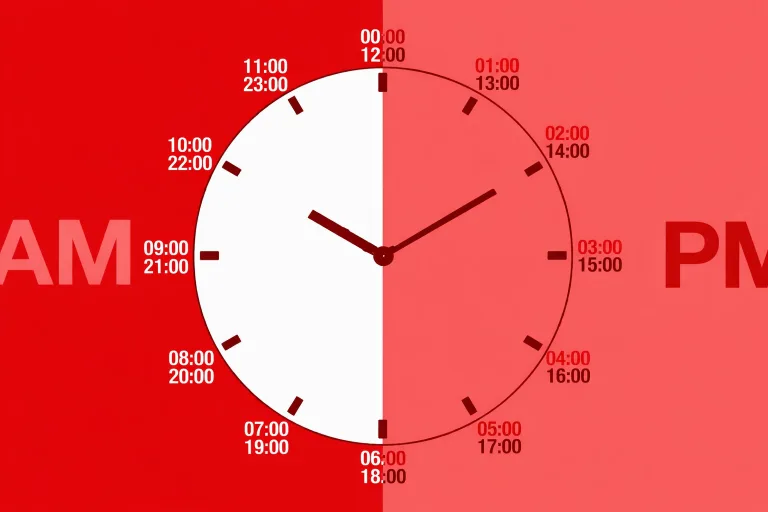
Easy-to-Read Military Chart (12-Hour vs 24-Hour)
Here is a clear comparison between the standard 12-hour clock and military times:
|
12-Hour Time |
Military Time |
|---|---|
|
12:00 AM (Midnight) |
00:00 |
|
1:00 AM |
01:00 |
|
2:00 AM |
02:00 |
|
3:00 AM |
03:00 |
|
4:00 AM |
04:00 |
|
5:00 AM |
05:00 |
|
6:00 AM |
06:00 |
|
7:00 AM |
07:00 |
|
8:00 AM |
08:00 |
|
9:00 AM |
09:00 |
|
10:00 AM |
10:00 |
|
11:00 AM |
11:00 |
|
12:00 PM (Noon) |
12:00 |
|
1:00 PM |
13:00 |
|
2:00 PM |
14:00 |
|
3:00 PM |
15:00 |
|
4:00 PM |
16:00 |
|
5:00 PM |
17:00 |
|
6:00 PM |
18:00 |
|
7:00 PM |
19:00 |
|
8:00 PM |
20:00 |
|
9:00 PM |
21:00 |
|
10:00 PM |
22:00 |
|
11:00 PM |
23:00 |
|
12:00 AM (End of Day) |
24:00 |
Both 00:00 and 24:00 can represent midnight, depending on context. In scheduling, 24:00 is often used to show the end of a day, while 00:00 marks the start of a new one.
Military Time Converter Chart
A Military Time Converter helps you quickly switch between the standard 12-hour clock and the 24-hour military time format. Instead of doing manual calculations, you can enter a time and instantly see its correct conversion, making it useful for daily scheduling, work shifts, travel planning, and professional use.
This tool is especially helpful for people who regularly deal with military time, such as healthcare workers, emergency responders, airline staff, and international travelers. Whether you need to convert morning hours or evening times, a military time converter ensures accuracy and removes any confusion caused by AM and PM
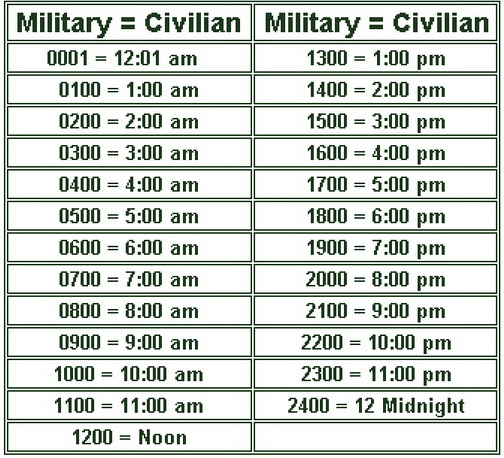
How to Read Military Time Without Memorizing Everything
Reading military time becomes easy once you understand two simple rules.
Rule 1: Morning hours stay the same
From 00:00 to 11:59, military times matches the standard clock.
Example:
- 7:30 AM → 07:30
- 10:15 AM → 10:15
Rule 2: Add 12 for afternoon and evening times
For times after 12:59 PM, add 12 to the hour.
- 2:00 PM → 14:00
- 6:45 PM → 18:45
- 10:00 PM → 22:00
That’s all you need. Once your brain gets used to it, the conversion becomes automatic.
How Military Time Is Spoken and Written
When spoken aloud, military times follows a specific format:
- 07:00 is said as “zero seven hundred” or “oh seven hundred”
- 13:30 is spoken as “thirteen thirty”
- 22:15 is spoken as “twenty-two fifteen”
In written military and aviation contexts, the colon is often removed:
- 07:52 → 0752
- 18:40 → 1840
This format improves clarity in written communication, especially in logs, reports, and operational documents.
Time Zones, GMT, UTC, and Military Suffixes
Military time is often combined with time zone indicators.
- Z (Zulu Time) represents Greenwich Mean Time (GMT) or Coordinated Universal Time (UTC).
Example: 0752Z - J (Juliet) refers to local time
- R (Romeo) refers to Eastern Time
Each time zone has a designated letter to prevent confusion during international operations. This system is still actively used in global aviation, defense, and navigation.
Who Uses Military Time Today?
As of 2026, the 24-hour clock is standard in many industries:
- Armed forces and defense organizations
- Hospitals and emergency services
- Airlines, airports, and rail networks
- Weather agencies and meteorology
- Astronomers and scientific institutions
- Computer systems, servers, and databases
- International businesses and logistics
In many countries, military time is simply called “standard time” and is used in everyday life.
Military Time Converter and Practical Use
You don’t always need a calculator or chart. With practice, your brain learns the pattern. However, digital military time converters are still useful for quick checks, scheduling across time zones, or avoiding errors in professional environments.
Military Time vs Other Time-Keeping Systems
Military time is just one way humans track time. Other systems include:
Despite all these methods, the 24-hour clock remains one of the most practical and error-free systems ever created.
Final Thoughts: Why Military Time Still Matters in 2026
Military time isn’t about being complicated—it’s about being clear. In a world where precision, automation, and global coordination matter more than ever, the 24-hour clock continues to be the most reliable way to measure time.
Once you understand the logic behind it, military time stops feeling foreign and starts feeling intuitive.
If you can read 18:30 and instantly think “6:30 PM,” you’ve already mastered it.